From your engineering correspondent - BC electronics part 1
An introduction to the electrics on board (part 1)
Mark O - 31/05/2026
As we are over halfway between Faroes and Iceland and we are on a peaceful starboard tack and after a mid-morning snooze I thought I might offer the promised, if not keenly anticipated, insights into the electrical aspects of Belle Colombe and some of the challenges they pose. Given the scope I will divide this into two blogs - the first covering the basic underpinnings and the second the navigation and domestic systems.
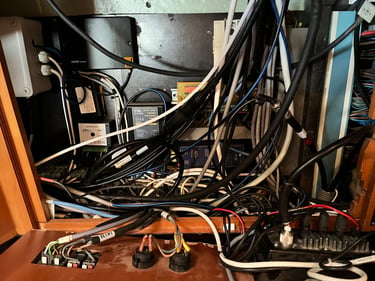
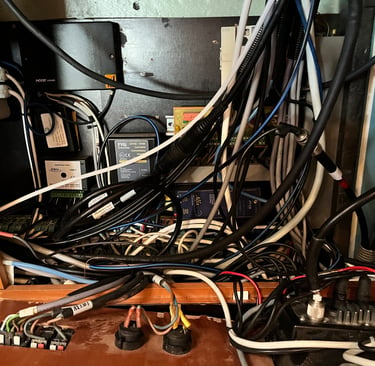
As with any boat that has had several previous owners the electrical systems have been ‘updated’. The original wiring was ‘comprehensive’ and new devices and their wiring has been added, usually over the top of the old wiring. And as there was never a wiring diagram of the harness in the first place…well you get the picture. Opening a panel usually results in the engineer blanching, muttering something about keeping his fingers crossed and rapidly replacing it. When we did our excellent 12V marine electrical course at Chieftain Training in Hamble the instructor enthusiastically said we should take time to trace and label all the wiring - well I have news for him…
The boat runs a 24V domestic and navigation system powered when at sea from a bank of six very large ‘service’ batteries wired to create a high capacity domestic bank. Navigation electronics are powered by four of the same type of battery. As you might expect with the size and weight they are located low and in the centre of the boat and until we had modifications made largely inaccessible without stripping a lot of boards and panelling away.
We have a 12V engine start bank of two batteries purely for the engine. Similarly we have two of the same type of the battery for the generator start bank. These are somewhat more accessible.
On top of that, the bow and the stern thruster each has their own pair of batteries located in the bow and stern lockers respectively.
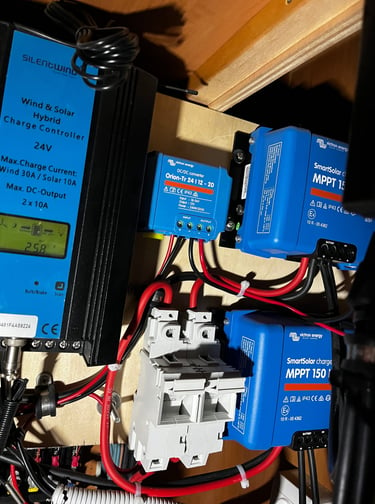
At sea we can charge the batteries either from the generator, directly from the two alternators attached to the main engine (one alternator charges the 24V systems and the other the 12v systems) and trickle charge from solar panels and a wind turbine. We also have a hydro generator (a propellor driven by water flow) under the boat but it is disabled - we have gone through several propellors as the plastic blades snap easily on whatever we snag and this creates vibration and noise when it is unbalanced and is inaccessible while at sea. So we have removed the propellor.
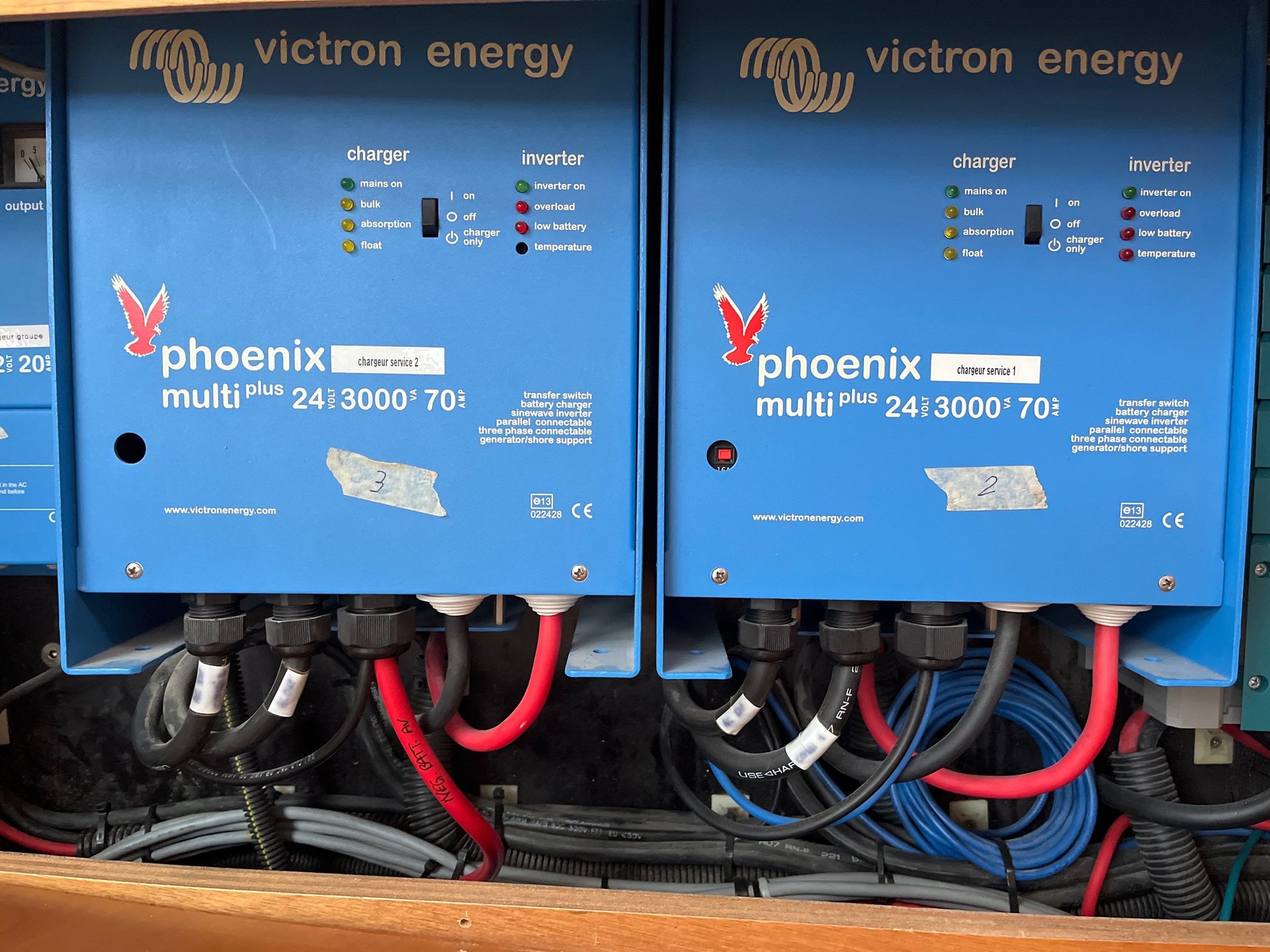
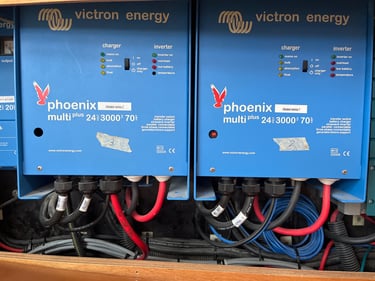
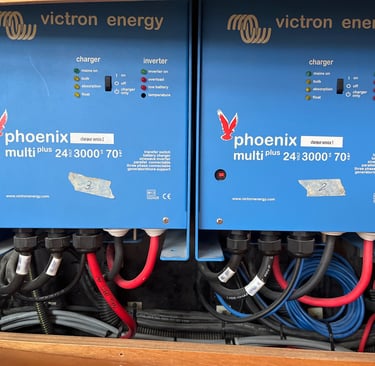
When we are alongside we can connect to shore power. Both shore power and the generator produce 220V and this is handled by two Victron chargers/inverters which charge the 24V systems and provide the means to convert 24v to 220v AC to power the 220v sockets within the boat. Another Victron charges the 12v banks. The inverters allow us to use 220v devices such as a kettle, toaster, microwave or washing machine at sea running off our service batteries - all mod cons. Because we can run 220v devices on the boat we have a comprehensive (and french labelled) circuit breaker set together with the controls to govern whether they are powered from the batteries, the generator or shore power.
We are also carrying (but have not yet fitted) something called a Victron AutoTransformer - this deals with the challenge of handling 120v Canadian and US power and converting it in to the 220v that the boat uses. No doubt someone clever will ask about handling the difference between 50Hz EU and 60Hz US electricity - to which the answer ‘is alright clever clogs - if you know enough to ask that question you can answer it!’
It all gets quite complicated and needs checklists to get it all right. And of course, being an aluminium hull it all starts to get quite interesting as electricity and metal have a certain affinity.
So that is the basic electrical backbone of the boat. Next up I will talk about navigation electronics, heating and other ancillaries.
Any questions please ask...
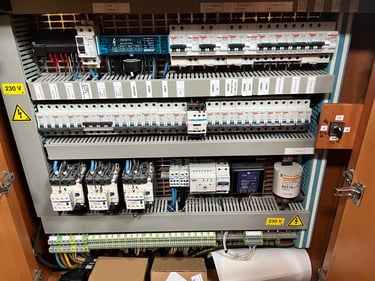
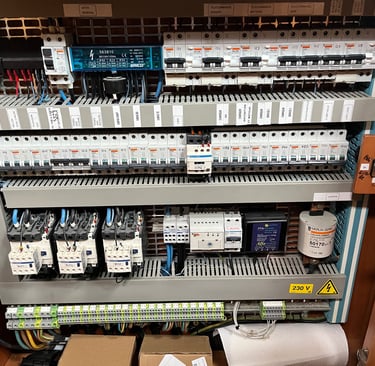
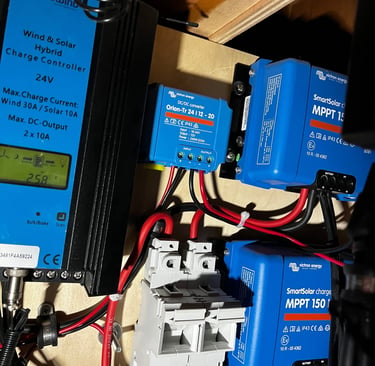
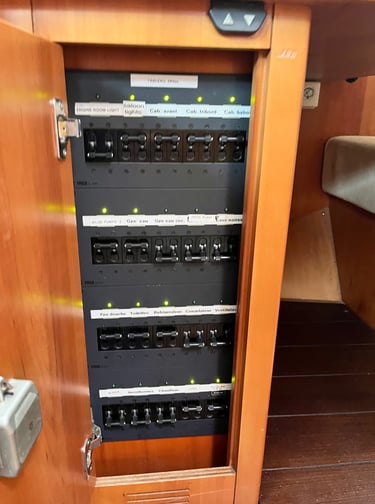
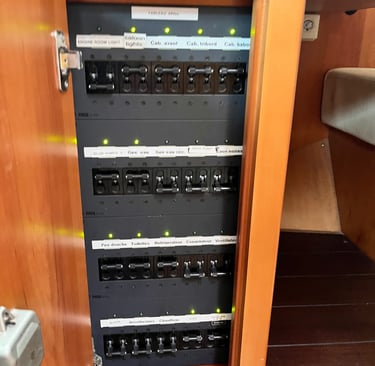
The 'neat' - our 220v breaker panel
The 'not so neat' - behind a panel
Our main charger array
Controls for wind and solar
Our 24V breaker panel
© 2026. All rights reserved.


Please check your inbox for an email request to verify your email